
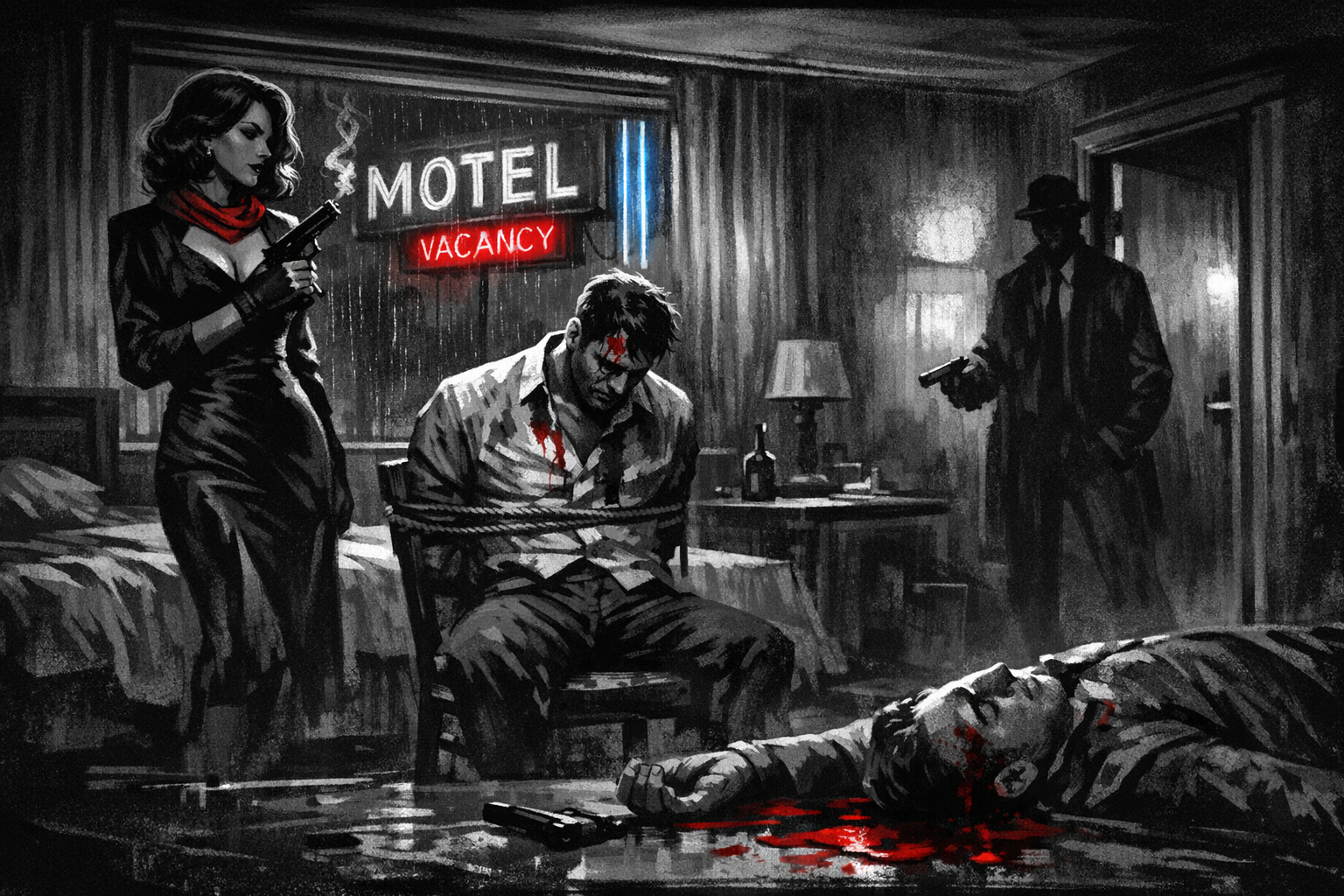
It’s 3:33 a.m., the hour when rational thought slips out the back door for a smoke and the walls start whispering dirty secrets. Fil’s got blood under his nails again. Not his. Not recently. Maybe metaphorical. Depends on who’s asking.
He’s parked in a rust-coloured diner booth that smells like old eggs and last chances. There’s a coffee cup sweating in his hand and a waitress named June who doesn’t blink anymore. Not since she started dreaming in reverse. The city outside the grease-filmed window is called Carrow, and Carrow is the kind of place that used to have ambitions. You can still see the scars of them in the empty office towers and the half-finished parking garage on Meridian that stopped construction in 2009 and has been slowly filling up with pigeons and bad intentions ever since.
“You ever hear God in the static?” Fil says, to no one in particular. He’s addressing the jukebox. Or the fly tapping Morse code on the salt shaker. Or maybe the neon sign across the street, throbbing with an arrogance usually reserved for deities and former televangelists.
The sign. That sign.
Triangle. Star. Buzzing like a migraine with aspirations. It pulses in time with Fil’s skull, like it’s syncing with the meat metronome in his head. Red and blue and something else—a colour that didn’t have a name yet, a colour that shouldn’t exist in any visible spectrum but somehow slid in anyway, the way a con man slides into a funeral. It appeared three weeks ago in the abandoned lot at the corner of Haverstock and Ninth, installed sometime in the dark between Tuesday and Wednesday, and nobody could say who put it there or why. The lot had been empty for six years. Before that, a printing press. Before that, a slaughterhouse. The ground there had a memory, and like most memories, it wasn’t good.
Fil has been writing poetry on receipts and napkins, each line scribbled like a confession scratched on the inside of an asylum wall.
The neon bled truth
But no one wanted it
So we ate the lie instead.
He used to be published. Used to be quoted in fringe zines and on the inside flaps of self-help books for people who’d already given up. His one real collection, The Cartography of Rust, sold four hundred copies, which was four hundred more than his mother predicted and six hundred fewer than his editor hoped. Now his work is mostly appreciated by the alley raccoons behind the diner, who seem to regard his crumpled napkin drafts as both literature and nesting material.
June refills his cup without making eye contact. Her name tag reads Ask Me About the Apocalypse in Sharpie. Fil doesn’t. He already knows the punchline.
Across the street, a man in a business suit is screaming at the sign, weeping like he’s just seen the face of God and it’s laughing through a cracked CRT. Then he’s gone. Poof. No scream. No puff of smoke. Just a brief shimmer in the air, like heat haze or a digital artefact in a corrupted memory file.
Fil nods.
“That’s the third one today,” he mutters, mostly to his spleen. “Or maybe the first. Depends on where you start counting.”
He pulls a battered transistor radio from his coat pocket. It’s held together with duct tape, broken prayers, and what might be dried soup. He clicks it on. Nothing but static.
Beautiful, sacred static.
Within it, the whispers start. A sermon in entropy. Words no human mouth could form. Ancient vowels uncoiling like snakes in a warm bottle. Fil closes his eyes and listens the way a priest listens to confession—not for judgment but for the texture of sin, the weight of it, the particular grammar of human failure.
June hums along, a tune no one taught her.
The walls breathe.
Fil smiles and scribbles on a sugar packet:
When the universe ends,
It won't be with a bang—
It'll be an out-of-service tone
and a neon apology.
The sign flares. And somewhere, something ancient purrs.
Three blocks south and one world away, Rosa Reyes is welding at midnight because sleep has become a country she no longer has a visa for.
Her garage—Reyes Auto, painted in block letters above the roll-up door that sticks unless you know to kick it on the lower left—smells of motor oil and ozone and the particular metal-tinged air that comes off a MIG welder running hot. The cars wait in the darkness beyond the work lamp’s reach like patient animals. Rosa works on a ’94 Camry whose owner hasn’t come back for it, which is fine because Rosa isn’t really fixing the Camry. She’s fixing something else. She’s not entirely sure what.
The dreams started two weeks ago.
In the dreams, the sky is not sky. It’s a surface. Vast and featureless and grey-white, like the belly of something enormous lying flat across the top of the world. And in the surface, there are seams. Fault lines. The kind of stress fractures she recognises from metal fatigue, from the places where load-bearing structures have been asked to hold too much for too long. In the dream she walks across rooftops with her welder on her back, dragging the cable behind her, and she repairs the seams one by one while something on the other side of the sky pushes against the cracks with soft, boneless pressure.
She always wakes before she’s finished.
Rosa is thirty-four. She has her father’s hands, wide-palmed and scarred, and her mother’s eyes, which are the dark brown of good soil. She came back to Carrow eight years ago to run the garage after her father’s stroke, and she has stayed because the staying turned into its own kind of inertia, the way objects in motion tend to keep moving until something stops them. Nothing has stopped her yet. Nothing meaningful.
She flips up her welding mask and squints at the work. The bead is good. Clean. Straight. She has an instinct for where the weak points are, for finding the place that’s about to give and reinforcing it before it does. It’s the only superpower she has, and it has served her well.
Through the thin gap under the roll-up door, the glow seeps in.
Red and blue and that other colour, the one without a name. The sign is blocks away but its light reaches everywhere now, threading through windows and under doors and into spaces that should by rights be dark. Rosa pulls off her mask and crouches to look through the gap. The light pulses slowly. One. Two. Three. Like breathing. Like a pulse.
Like something alive.
She has not walked to Haverstock and Ninth. She has not stood in front of the sign. She’s been careful about that. Careful in the way of a person who knows that some things, once looked at directly, cannot be unlocked. She’s seen what happens. Heard about the missing. Carrow has always chewed people up—it’s that kind of city—but this is different. This is targeted. Specific. Three days ago, a woman named Patrice who worked at the bodega on Eleventh didn’t open the store. Two days ago, a teenager named Marcus who skateboarded past Rosa’s garage every morning at seven failed to skate past. Yesterday, the business suit man, whose name Rosa didn’t know yet.
She stares at the light under the door and the light seems to stare back.
She picks up her welding mask and puts it back on, not because she’s going to weld but because the tinted glass makes the light bearable. Through the dark lens the sign’s glow resolves into something almost comprehensible, a shape within the light, a geometry that pulses and breathes.
Rosa stands up and turns away from it.
She doesn’t sleep until four.
Dex Hollowell keeps a notebook. It’s a standard composition book, black and white marbled cover, the kind that costs a dollar nineteen at any drugstore. In it he writes names.
He’s written thirty-one names in three weeks.
Dex used to be a cop. He used to believe in the system the way young men believe in the systems that briefly reward them, which is to say completely and without nuance. Then the system revealed its actual dimensions—wider in some places than the law, narrower in others—and Dex made a series of choices that ended his career and which he has spent the subsequent four years variously justifying, regretting, and trying to balance out with vigilante arithmetic. He’s not a superhero. He doesn’t have a costume or a code name or a tragic origin that the camera would linger on. He’s just a man who knows where the bodies are buried because he helped bury some of them and is now trying to dig them back up.
He’s forty-one. Lean in the way of people who forget to eat. His face has the look of a place where something used to live.
He stands on the roof of the Meridian parking garage at half past three in the morning, watching the sign.
From up here, the geometry is clearer. The triangle points upward. The star—five-pointed, slightly irregular, as though drawn by a hand that was either drunk or working from a geometry that isn’t Euclidean—sits centered within the triangle. The neon tubes trace these shapes in blazing red and blue, and between the tubes, in the gutters of dark glass, the unnamed colour swims. It is not a reflection. It is not a function of angle or distance. It is simply there, occupying the space between the things you can name.
Dex has been asking around. He has talked to the families of the missing, which is the kind of conversation that strips the chrome off your chest and leaves you hollow. He has talked to street people and shopkeepers and the few neighbours who remain in the two-block radius around the sign where, inexplicably, real estate values have not crashed but have instead risen sharply, because rich people in Carrow apparently believe the sign is art.
He talked to June at the diner. She hummed something at him and refilled his coffee twice and said, with absolute serenity, “It’s been doing that forever. We just didn’t have the antenna for it before.”
He talked to a man named Gus who ran a newspaper stand on the corner who said he’d gone to stand in front of the sign the first night it appeared and had lost six hours and come back with his shoelaces tied in knots he couldn’t identify and the unshakeable conviction that the stars were looking at him. “Not watching,” Gus said carefully. “Looking. Like when you make eye contact with something. Like when it knows you’re there.”
Gus hasn’t been back since. Smart man.
Dex has identified a pattern in the disappearances: they cluster around the times when the sign pulses fastest, which he has clocked at approximately 3:00 to 4:00 a.m. and again between noon and 1:00 p.m. He has written this in his notebook between the names. He has also written: not random—selective. And below that: feeds on something specific. And below that, the question he hasn’t answered yet: what?
The sign flares.
In the abandoned lot below, near the chain-link fence, Dex spots a figure. Small. Dark coat. Face turned up toward the light.
He watches for a long moment, then pulls out his notebook and uncaps his pen.
He writes: not yet. Then he goes downstairs.
The lot smells like old concrete and something sweeter underneath, something floral and chemical that shouldn’t be there. Dex walks the perimeter first, which is a habit that kept him alive as a cop and has become a kind of prayer since. The figure he spotted from the roof is a woman, mid-thirties, wearing mechanic’s coveralls and a welding mask pushed up on her forehead like a visor. She’s crouching near the chain-link fence with a flashlight, looking at the ground.
“There are symbols,” she says without looking up, as if she knew he was coming. “Cut into the concrete slab. Under the sign’s base. Come look.”
Dex comes and looks. She’s right. The slab the sign stands on—poured recently, the grey still clean—has been incised with a ring of symbols around the base. Not graffiti. Not anything decorative. They’re cut deep, with precision, in a script that looks like it’s trying to be multiple alphabets simultaneously and failing elegantly.
“Rosa Reyes,” she says, standing and offering her hand. “Reyes Auto on Ninth.”
“Dex Hollowell.” He shakes it. Her grip is like a wrench. “Former CPD.”
“I know. I remember the thing with the Colson case.”
Dex’s jaw tightens. “Yeah.”
“I don’t care,” she says simply, which is either forgiveness or practicality, and with Rosa he’ll later learn these are often the same thing. “Have you seen the texts?”
“What texts?”
She pulls a canvas bag off her shoulder and removes a bundle wrapped in a plastic shopping bag. Inside the plastic is a manila envelope, and inside the manila envelope are photocopies—grainy, slightly crooked, the kind made on a machine that was low on toner—of what appear to be diary pages.
“Found them in the empty unit above my garage this morning,” she says. “Place has been locked up since before I took over from my dad. The lock was broken from the inside.”
Dex takes the photocopies and angles his flashlight over them.
The handwriting is cramped and slopes steeply to the right, as though the writer was always about to fall over. The date at the top of the first page reads October 1923.
A man’s voice behind them says: “The previous tenant, presumably.”
They both turn. Fil is standing at the gap in the chain-link fence, holding a transistor radio and a paper cup of diner coffee. He looks like a shipwreck survivor who has decided to treat the shipwreck as a creative opportunity.
“Fil Danvers,” he says. “I used to write poetry.”
“Did you stop?” Rosa asks.
“No,” he says. “I just lost the audience.” He holds up the transistor radio, which is emitting gentle static. “I’ve been hearing it in here for weeks. Came to check if what I’m hearing is what I think I’m hearing.” He looks at the sign. The sign looks back. “It is.”
Rosa takes the photocopies from Dex and hands them to Fil. “Can you read this?”
Fil looks. His eyes move down the pages with the particular focus of someone whose brain, even in its current state, is wired for language. He reads. He reads for three minutes in the cold light while Rosa and Dex watch the sign and the sign watches nothing and everything.
“Nineteen twenty-three,” Fil says finally. “Man named Edgar Voss. He was the foreman of the slaughterhouse that used to stand here. Says he found what he calls ‘the geometries’ carved into the stones of the foundation when they were renovating the killing floor. Started hearing—” Fil pauses, flips to the next page. “Started hearing voices in the—good lord—in the screaming of the animals. Not the animals themselves, he says, but something speaking through the resonance of the fear.” Fil looks up. “He says the slaughterhouse was built on a point of ‘convergence.’ He uses that word three times in two pages. And here—” he angles the flashlight, reads— “‘the geometries are a door, and the suffering is the key, and what waits beyond the door has been waiting since before the world learned to be afraid.'”
The sign pulses. Once. Twice. Three times, then faster.
“What does it want?” Dex asks.
“Voss says—” Fil turns to the last page. His voice flattens slightly, the way voices do when the content outruns the speaker’s composure. “He says it feeds on despair. Not just sadness. He’s specific about the distinction. It’s the particular flavour of despair that comes from hope that has turned. Optimism that has curdled. He calls it ‘the sweetness of the ruined thing.'”
The three of them are quiet for a moment.
Rosa looks around at the city. At the dark towers. At the half-finished parking structure. At the empty storefronts and the payday loan offices and the community centre whose roof caved in last spring and which the city has not gotten around to repairing.
“Well,” she says. “It picked the right neighbourhood.”
The city started dreaming badly around day seventeen, which was last Tuesday.
It wasn’t just the people nearest the sign. It spread outward through Carrow like a dye in water, following routes that didn’t correspond to streets or sewer lines or any other infrastructure humans had built. It followed older channels. The lines of old fear. The routes that a thing that had been feeding on a city’s despair for—how long, exactly? Fil found another page, this one in what appeared to be medieval Latin, photocopied from a text Voss had found in the slaughterhouse’s basement and which he described only as bound in something he did not wish to identify. The Latin said the entity had no name in human language. It had a symbol, which was the triangle-and-star. It predated the city. It predated the continent. It had been dormant here for centuries, sleeping in the earth, waiting for the convergence of sufficient despair. Waiting, Fil read, for a moment in human history when the cup of hope ran dry enough that its absence could be tasted on the air.
It was Thursday before the streets bent.
Dex saw it first. He was walking Meridian toward the sign—they’d been making nightly reconnaissance runs, building up what passed for a tactical picture—when the street ahead of him curved in a direction streets do not curve. Not a gradual arc but a geometric deviation, a sharp angle like a fold in a piece of paper, that shouldn’t have been possible given the architecture of the buildings on either side. He stopped walking. He blinked. The angle persisted.
From around the impossible corner came a group of people walking in single file, faces turned up and to the left, all of them wearing expressions of absolute desolation that had somehow, through some alchemical process, become peace. They moved without speaking. Their feet made no sound on the pavement. As they passed Dex, he saw that two of them were wearing business attire. One was wearing a t-shirt he recognised from a missing person notice stapled to a telephone pole. One was very small, no older than twelve, and her sneakers were the iridescent kind that caught light and scattered it, and they lit up with each silent step.
Dex did not follow them. He stood very still and watched them walk until they were gone.
When he found Rosa and Fil at the garage that night and told them, Fil nodded as though he’d expected this.
“They’re not gone,” Fil said. “They’re held. Like the words in the static. Present but inaccessible. He’s building something.” He looked at his notebook, which was covered in scrawled lines from edge to edge, front to back. “This is what the diary describes. The gateway needs to be fed before it opens fully. Every person taken is—fuel. Or currency. Or both. The geometry has to be charged.”
“How long until it opens?” Rosa asked.
“Voss didn’t say. His diary ends.” Fil looked up. “Mid-sentence. Mid-word, actually.”
The three of them sat with that for a while.
The garage smelled of oil and burning. Rosa had a second welding setup in the corner, and she’d been working on something for three days that she hadn’t shown them yet. Dex noticed the tarp covering it and didn’t ask, not yet. He’d learned already that Rosa moved on her own internal schedule and that the schedule was sound.
“If the door opens,” Dex said, “what comes through?”
“Something for which ‘door’ is too small a word,” Fil said. “Something that will make the current arrangement—where it sips at the city through a conduit—look like the dignified option.”
Rosa pulled off her welding gloves and laid them flat on her workbench with a precision that suggested decision.
“Then we go tonight,” she said.
By midnight the unnamed colour had spread beyond the lot. It traced the gutters and gathered in standing water and pooled in the shadows of doorways in a way that shadows don’t, in a way that suggested less the absence of light than the presence of something that ate light and converted it to this, to this bleeding iridescence that was wrong in the way that a key can be wrong for a lock—not incompatible, but inverse. Made for the same hole from the other side.
They went at 2:00 a.m. Fil with his transistor radio, Rosa with the thing from under the tarp—which turned out to be a handmade electromagnetic disruptor built from a car alternator and several hundred dollars’ worth of components she’d ordered online during the first week, while she was still pretending to herself that it was just a weird light installation. Dex with his notebook and a pry bar.
“What’s the pry bar for?” Rosa asked.
“I don’t know,” Dex said. “Feels like the kind of situation where you might need a pry bar.”
She didn’t argue. You don’t argue with a man’s relationship to his pry bar. It’s too personal.
The lot was empty. Or appeared to be. The sign blazed overhead, the triangle-and-star burning at a frequency that Fil could feel in his molars, a vibration that wasn’t quite sound but was adjacent to it, occupying the register just below. The symbols on the slab glowed softly, not from neon but from within the concrete itself, as though the marks had ignited something in the stone.
Fil turned on the transistor radio.
The static was enormous. Not the comfortable white noise of his diner sessions but something massive and directional, something that filled the air between them and the sign like a physical medium. It pressed against his chest. It smelled, absurdly, like a library. Old paper and old thoughts and the slow decomposition of knowledge.
In the static, the voice.
Not whispering now. Speaking.
It spoke in a language that was not a language so much as a direct impression on the mind, a meaning that bypassed the ear and lodged in the oldest part of the brain. The part that remembers being small and slow and edible, the part that knows what it is to be seen by something that doesn’t intend you well.
What it said—or rather, what it transferred—was this: it was old. Older than anything the word old could hold. It had watched civilisations arise and collapse the way a gardener watches annuals. It had been here, in this ground, in the resonance of screaming and slaughter, for longer than the city, longer than the country, longer than the language in which they were currently failing to think about it. It did not hate them. It did not love them. They were sustenance and they were a door and the door was almost open and they were very small and they were afraid and their fear was delicious and there was no version of this conversation in which they won.
Rosa turned on the disruptor.
The noise it made was like two freight trains arguing about philosophy. The unnamed colour in the gutter-shadows flickered and stuttered. The symbols on the slab dimmed slightly, then blazed back harder.
The entity’s presence shifted. Reoriented.
And then the three of them understood what Voss had understood in 1923, which was that you cannot fight a thing like this on its own terms. You cannot out-fear it. You cannot out-despair it. These are the waters in which it swims. These are the conditions in which it is strongest.
Fil understood it first, because he had been living in his own despair for so long that he recognised, in the entity’s feeding-pressure against his mind, the specific flavour of his own ruination. The curdled hope. The cartography of rust. His whole career, his whole life reduced to receipts and napkins and an audience of raccoons. The entity found these things and opened them and made them enormous, made them fill his entire field of vision, and for one long terrible moment he was nothing but his own failure, standing in a vacant lot in the city where failures come to confirm their condition.
In that moment the static on the radio resolved into clarity, and what came through was not a divine voice but a mundane one. His own. Reciting, in the clear flat cadence of a man who has made peace with something, a poem he’d written on a sugar packet weeks ago and then lost.
He found himself finishing it. Out loud. Into the air.
“When the universe ends, it won’t be with a bang. It’ll be an out-of-service tone. And a neon apology. But the tone goes on. And so do we.”
The entity recoiled. It wasn’t much. A tremor. But it was real.
Rosa was on her knees, and Dex understood from the look on her face that she was seeing what he feared she might see: the accident, seven years ago, the car she couldn’t fix fast enough, the brother who died in it. He had heard the story sideways, from street conversations, from the way she spoke about the accident the way people speak about the weather because it’s always there. The entity had found it and was turning it like a blade. Look, it seemed to say. Look at the thing you couldn’t fix. Look at the seam you failed to close.
Dex put his hand on her shoulder. Not gently, not softly—firmly, like a load-bearing structure. She looked up.
“You fixed the other one,” he said. He meant it in terms of her brother—there was a second sibling, he was almost sure, he’d heard that too—but even as he said it he understood that Rosa was receiving it as the broader truth. You fixed the other ones. You fix them every day. The cars, the seams, the cracks in things.
Rosa stood. Her jaw was set. She picked up the disruptor and adjusted the frequency and the sign’s buzz dropped a register, like a power grid losing a phase.
The entity turned toward Dex.
He’d been waiting for it. He had his notebook out and he held it up between them like a shield, which was both practical and entirely symbolic and Dex had accepted by now that these were the same thing here. The entity showed him the things he’d done. The things he’d covered up. The three years of being what the department needed him to be rather than what the law required. It showed him the faces of people he’d failed or worse and it made them into a kind of panorama, a full-circle visual confession, and it said, in its language of direct impression: you are this. This is all you are. You are defined by your worst moments and your worst moments are the majority.
Dex thought about the notebook. Thirty-one names. Thirty-one people who were still, somehow, somewhere—held in the sign’s charged geometries, waiting. Not gone yet. Present but inaccessible.
He opened the notebook to the first name. Read it aloud. Then the second. Then the third. He didn’t do it dramatically. He did it the way you do the thing you have to do, which is just by doing it. Name after name, quietly, deliberately, as if the act of naming was itself a form of retrieval. A refusal of the entity’s arithmetic. These people were not fuel. They were not currency. They were: Patrice. Marcus. The business suit man (Armand, his wife had told Dex, Armand Karel, fifty-two, liked fishing). The twelve-year-old with the light-up sneakers, Jade.
By the twentieth name the sign was shaking.
Fil understood what was needed.
He’d been understanding it for the last several minutes and working very hard not to understand it, the way you work hard not to look at the check when you already know you can’t pay it. But the understanding had arrived fully formed and there was no more room to pretend otherwise.
He reached into his coat and removed his notebooks. Not the current one—all of them. He had four tucked into various pockets, which said something about either his organizational system or his psychological state. Every poem he’d written in the last six months. Every receipt, every napkin fragment, every sugar packet. The complete works of Fil Danvers, period three: the period in which he’d been living at the edge of the sign’s influence and writing his way through it. The words it had whispered to him. The shapes it had shown him. Hundreds of lines of poetry that were also—and this is the part he’d been not-understanding—a map. A map of the entity’s architecture, drawn in language, assembled line by line from the transmissions he’d thought were inspiration but were actually dictation.
He had been writing its door open. Word by word, night after night, in the static gospel of 3:33 a.m.
Fil is fifty-one years old and published four hundred copies of one real collection and the rest has been fragments and static. He knows what these notebooks contain. He knows they are the best work of his life. He also knows, with a terrible clarity, that the best work of his life has been the construction of a gateway to something that will devour every remaining good thing in a city that cannot afford to lose any more good things.
He pulled out his lighter.
Rosa saw what he was about to do and said, “Fil—”
“It mapped itself through me,” he said. “The whole architecture. That’s why it was so good.” He paused. “That’s why it was so good.”
He lit the corner of the first notebook.
The fire was orange and ordinary and gorgeous. The notebooks caught well—they were dry, filled with dense handwriting, and the paper was the cheap kind that Fil had always used because expensive paper felt presumptuous. The flames lit his face from below and he looked, briefly, like a man who has solved the problem he was born to solve and is not entirely happy about the solution but has made his peace with it.
He held them toward the sign and the sign’s buzz rose to a scream that no human ears should have been able to process but all three of them processed it anyway, in their bones and their back teeth and the soft tissue behind their eyes. The entity lurched. The unnamed colour in the shadows began to collapse inward, like a fire consuming itself, like a wave pulling back from shore.
The symbols on the slab flared white. Then went dark.
One by one, the neon tubes in the sign went out. Red first. Then blue. The triangle-and-star remained for a moment in the geometry of the dark glass, visible only by implication, by the shape of its absence. Then the glass cracked—not explosively, just a clean, tired fracture, the sound of something that has been under enormous pressure simply choosing to stop—and the unnamed colour guttered and went out like a candle.
The lot was just a lot.
The transistor radio played static for one long moment and then resolved, absurdly, into an old country song about leaving. Then it too went quiet.
Fil’s notebooks burned down to ash in his hands. He let the last of them go and the ash scattered on a wind that had no obvious source. His hands were clean. He hadn’t noticed until now.
Around four-thirty, they came back.
Not all of them. Seventeen of the thirty-one returned, materialising in the general vicinity of the lot over the course of about an hour, confused and cold and wearing the dazed expressions of people who have been somewhere there is no language for and are now grateful, desperately grateful, to be somewhere with language. Patrice sat on the kerb and wept and accepted the diner coffee June brought out to her without question. Marcus the skateboarder arrived without his skateboard and then found it, inexplicably, leaning against the chain-link fence. Armand Karel walked directly home to his wife, who had not slept in four days, and they stood in their doorway for a long time without moving.
Jade, the twelve-year-old, came back last. Her light-up sneakers were still working. She walked past the three of them standing by the dark sign, paused, looked at the empty lot, and said, with the calm authority of someone who has processed extraordinary things in a short time, “I dreamed about a library.”
“Yeah,” Fil said. “What was in it?”
“Everything that ever got lost,” she said, and walked home.
The other fourteen did not return. This is the thing Rosa sat with in the days after, the seam she could not close, the weld that didn’t hold. Fourteen names in Dex’s notebook that would not be followed by explanations. She is sitting with it still. It is the hardest part of the shape of what happened.
By morning, the lot had a crew in it. City workers in orange vests who had received a complaint, apparently, about a safety hazard in an abandoned space. They removed the sign’s broken frame and poured new concrete over the slab and its symbols. The concrete covered everything clean and grey and when it cured it was just a slab, and when the city eventually decides what to do with the space—because even in Carrow, land doesn’t stay empty forever—whatever they build there will be built on top of a memory the building won’t have access to.
The signs of the wider damage were subtler and stranger. Streets that had bent returned to their standard geometry, though one intersection on Meridian was off by about three degrees that no surveyor could account for and the city eventually just repainted the lane markings to match the current reality and moved on. Several residents reported that their dreams cleared overnight, as though a frequency that had been bleeding into their sleep was abruptly shut off. One woman said she woke at 4:00 a.m. to find herself humming a tune she didn’t recognise, and that when she stopped humming it, she felt a small clean silence in its place, the silence of something that had needed to stop.
June stopped wearing the Apocalypse name tag. She went back to the original one. She also started blinking again, which was a relief to everyone.
Two weeks later, Fil is back in the booth. It’s 3:33 a.m. because of course it is. He’s drinking coffee and listening to the traffic and the silence, which in a city has layers—the surface noise and then the middle quiet and then, if you’re patient enough, the deep hum of the infrastructure, the electricity and water and gas running through the arteries of a place that persists because its people persist.
He doesn’t have his notebooks. He has a new composition book, black and white marbled cover, purchased this afternoon from the drugstore. He has written nothing in it yet. He has been writing nothing for two weeks and he is finding that the nothing has a texture of its own, a quality of space, of room. The first draft of the next thing. The empty lot before the building.
June pours his coffee and says, “You look better.”
“I look the same,” Fil says.
“That’s not what I said.” She moves on down the counter.
Through the window he can see the lot. There’s chain-link around it and a new concrete slab and the city has put up a small sign that reads: FUTURE DEVELOPMENT SITE. It is the most optimistic thing he has seen in Carrow in years, and it is optimistic in the specific civic sense, which means it’s probably wrong, but it’s there.
Fil opens his notebook and writes a line.
Carrow breathes.
Badly, yes—
but breathing.
He reads it back. It is not the best line he’s ever written. It is not the worst. It is a true line, which is what lines are for, and he will see what grows around it.
He clicks on the transistor radio. Pure static. No whispers. No sermon in entropy. Just the beautiful democratic noise of the world talking to itself in every frequency at once, nobody listening, nobody needing to.
Dex’s notebook has thirty-one names. Seventeen of them have a single mark beside them, a small check, the kind you make when something on a list has been addressed. Not resolved. Not closed. Addressed. He keeps the notebook. He’ll keep it until he doesn’t anymore. The fourteen names without marks are not accusations. They are just weight, which he is learning to carry the way you carry weight—not by pretending it’s light but by getting stronger and going on anyway.
He took a job last week. Security consultant for a logistics company. It pays and it doesn’t require him to be what the old system needed him to be. He told Rosa about it and she said, “That’s good,” with the economy of someone who means what she says and stops when she’s done meaning it.
Rosa is in the garage. It’s late. The Camry is gone—finally picked up by its owner, who came back looking sheepish and a little confused, the way people in Carrow often look—and there is a ’71 Chevelle on the lift that has been brought in from two towns over by someone who specifically sought out Reyes Auto after hearing Rosa’s name from a friend. It needs significant work. Rosa has assessed the damage and written up the job and it is long and it is hard and she is going to do it right.
She works with the radio on. The station plays an old soul song about a woman who has seen the worst and keeps walking. Rosa has heard it a thousand times. It still sounds true.
Above the garage, the sky is just sky. She doesn’t need to look to know. She doesn’t dream about it anymore. She stopped dreaming about the fault lines when the sign went dark, and what replaced the dream was something harder to describe—a feeling of solidity, of having stood in the place where the ground was weakest and not fallen through. She is not naive enough to think there are no more seams to close. There are always more seams. That’s why the trade exists.
She bends back to her work. The welder hisses. The metal takes the heat and yields and binds.
Across the city, people sleep. They dream ordinary dreams—the petty anxieties, the unfinished arguments, the falling sensation, the place you were trying to get to before the architecture shifted. Normal nightmares. The human kind.
And the unnamed colour is gone from the gutters, and the streets hold their expected angles, and the neon signs of Carrow—the real ones, the laundromats and the chicken places and the bar on Sully Street with the sign that has blinked off the first letter for six years—burn their ordinary reds and greens and blues against the dark like the city talking to itself. Like the city saying: still here. Still here. Despite everything, still here.
Which is not nothing.
Which, if you want to get into it, is the whole thing.